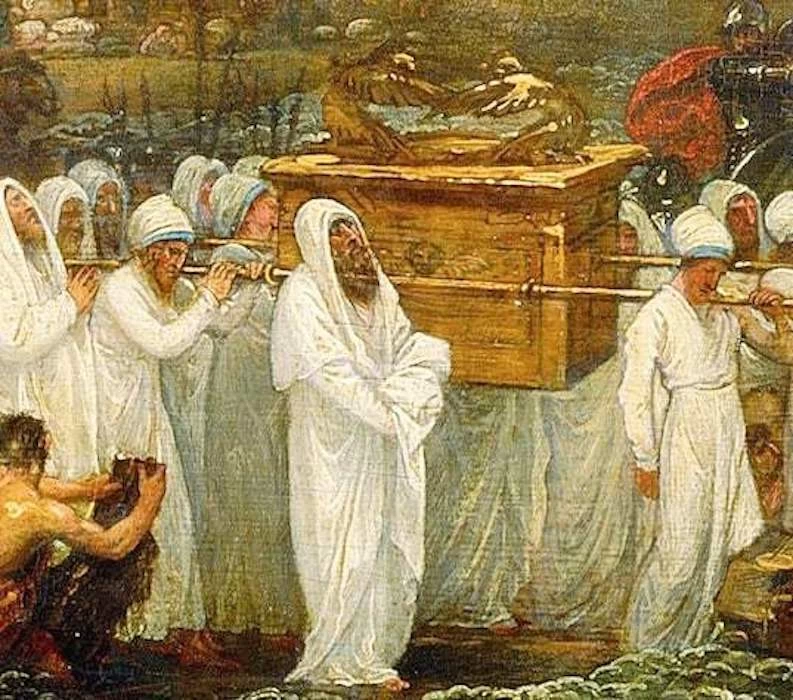
The Ark of the Covenant, the holiest of artifacts known to house the Ten Commandments, supposedly existed 3,000 years ago. Tradition indicates that Nebuchadnezzar stole it and destroyed it when the Babylonians sacked Jerusalem and plundered King Solomon’s Temple in 586 BCE. However, some experts believe that the real Ark survived. The most credible theory states that the Ark found its way to Ethiopia during King Solomon’s rule around the 10th century BCE – and may still be there today. Historians suggest that before WWII under Mussolini’s command, Italy made significant efforts to find it.
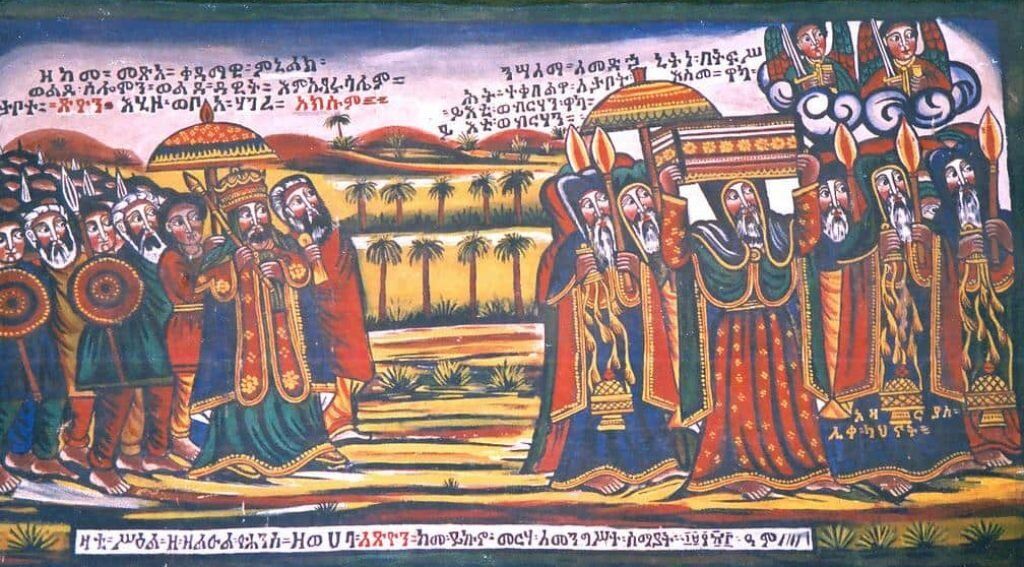
[blockquote align=”none” author=”Ephraim Isaac”]The Ark was a chest measuring 4 feet, 2 inches (2.5 cubits) long; 2 feet, 6 inches (1.5 cubits) wide; and 2 feet, 6 inches (1.5 cubits) high. It was made of shittim or acacia, overlaid with gold inside and outside and was fashioned by two of the most skilled Israelite craftsmen. A golden crown and two cherubs facing each other decorated the top. It was covered by a pure gold cloth called kaporet . . . . (Exodus 25:10–22, 37:1–9).[/blockquote]
Background Legend About the Ark of the Covenant
It all begins with Menelik I, son of King Solomon and Makeda, the Queen of Sheba, around 950 BCE. According to the legend, when Makeda visited the king, she became pregnant by him and gave birth in Abyssinia (Ethiopia). After Menelik reached adulthood, he traveled to visit his father in Jerusalem. When the time came for Menelik’s return to Ethiopia, King Solomon wanted a copy of the Ark to go with Menelik for prayer. After all, Ethiopia was so far away from the Temple in Jerusalem.
However, Prince Menelik I worried about the sanctity of the real Ark since Solomon had placed idols in the Temple along with the Ark at the request of his pagan wives. Menelik and his followers formulated a plan in which they would swap the Arks. Menelik would then assume care for the real one. First, the men ensured that the priests were drunk from wine. Then Menelik made the trade, and a group of Jews accompanied Menelik back to Abyssinia with the Ark.
Other versions of the story say that the king entrusted Menelik with the real Ark for safekeeping.
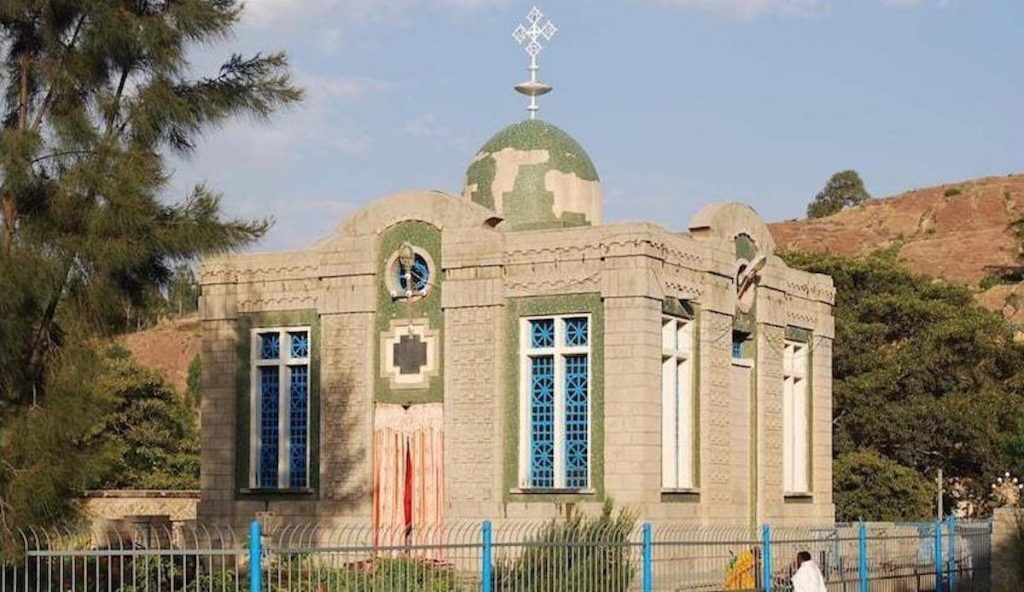
Nevertheless, the real Ark of the Covenant arrived with Menelik I in Ethiopia. It stayed at the Lake Tana Cherkos monastery for the next 800 years. Subsequently, it found its resting place at the Church of Saint Mary of Zion in Axum, Ethiopia. From that point to the present, just one monk known as the ‘Guardian of the Ark’ staffs the church. He remains in this sacred position until his death, and he informs all curious visitors that he and the rest of Axum would give their lives to protect the Ark. Only the Guardian is allowed to view the Ark, regardless of anyone’s position or wealth.
Italy Invades Ethiopia and Begins Quest
Italian polity of the 20th century considered Ethiopia to be in its sphere of influence. Additionally, it was one of the few African countries which still preserved its independence, free from European domination. Ethiopia had also skirmished with Italy in the past and won the engagement decisively. This occurred in 1896 when 14,500 Italian soldiers suffered a huge defeat at the hands of 80,000 Ethiopians in Adwa.
Fueled by the need for revenge and expansion by colonization, Mussolini sent his newly mechanized legions under the command of Field Marshal Rodolfo Graziani across the Abyssinian border from Italian Somaliland and Eritrea on October 3, 1935. (Comando Supremo).
What Was the Vatican’s Position on Ethiopia?
Abyssinia was quickly overrun. The League of Nations issued their protests. It seemed that only the Vatican kept quiet. Some speculate that the Vatican blessed the Italian invasion of Abyssinia for its own reasons. The Ethiopian Orthodox Tewahedo Church called itself the original Christian faith, as did the Roman Catholics at the Vatican. Certainly, it didn’t sit well when the Ethiopian Orthodox Tewahedo Church refused to accept the Pope as the supreme leader of the Christian faith.
Pope Pius XI was careful to not personally endorse the Italian invasion on Abyssinia. The potential backlash from Catholics worldwide would be enough reason to not support the war publicly. But many people believe that Mussolini obtained Vatican support for the invasion. This was, in part, because it would allow the Vatican to submit the Ethiopian Orthodox Church to its will.
Although Pope Pius XI was fairly quiet during Italy’s occupation of Abyssinia, other members of the Vatican were much more vocal. Archbishop of Torano was quoted as saying:
[blockquote align=”none” author=”Archbishop of Torano”]The war against Ethiopia should be considered as a holy war, a crusade (as Italian victory would) open Ethiopia, a country of infidels and schismatics, to the expansion of the Catholic Faith.[/blockquote]
The Search for the Ark
Ethiopia, with its long, rich history of Judaism and Christianity, claimed to possess the one artifact most desired by all the major religions: the Ark of the Covenant. The Vatican was certainly aware of this claim. Some speculate that the Vatican, as the representative of Christianity, wanted the world’s holiest artifact in its own possession. This too put them at odds with the Ethiopian Orthodox Church.
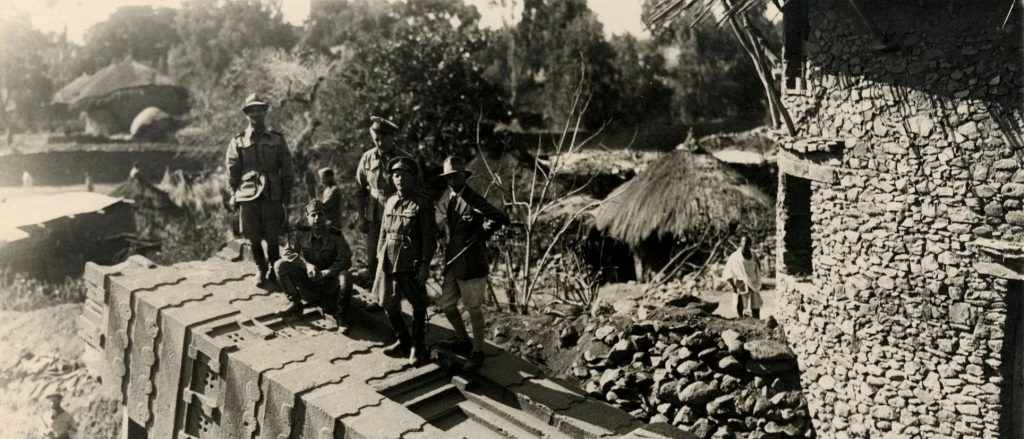
Did Fascist Italy, with the blessing of the Vatican, attempt to locate and remove the Ark from St. Mary’s church in Axum, Ethiopia? There are no official records that confirm this. However, Italian forces did seek Ethiopian national treasures and Italian soldiers did occupy Axum. In fact, the Italians removed the Great Stele, or Obelisk, of Axum, and they reassembled it in the heart of Rome. This feat alone shows that money was not an option. The transportation of this large object was an engineering feat unheard of at the time.
Security Measures to Guard the Ark
The Ethiopian Orthodox Church has a long history of moving the Ark for safekeeping. After residing in the Lake Tana Islands for more than 800 years, it was eventually moved to Axum in 333. On multiple occasions when the Ark was under threat, Guardians once again returned it to Lake Tana. In some instances, it relocated to other areas such as in Gonder, the caves of the Semien mountain, in Shewa, the Zeway Islands, and elsewhere.
As expected, Ethiopian religious officials claim the Ark was moved from Axum during the Italian occupation. To make matters even more confusing, the Amhara tradition also states that an exact copy of the Ark is in St. Mary of Zion church and the original Ark of the Covenant is the Ambesà (the Lion) mine. On the other hand, the St. Mary of Zion church claims that they have the original.
Regardless of the confusion, the Italian forces in Ethiopia during 1935-1941 left no stone unturned. Some estimates state that over 1 million Ethiopians lost their lives. Over 300 monks, nuns, and clergy were murdered, 2,000 churches were destroyed, along with 525,000 homes and 14 million livestock (Alemayehu). Were the churches burned down to subdue the Orthodox Church or to search for the Ark? Official records do not address this.
Italian Representatives Join the Hunt
The Ark is only one of many biblical ties Ethiopia has with Israel. It is interesting to note that many prominent Italian officials traveled to areas in Abyssinia either known for their historic relationship to the Ark’s location or because of their religious significance.
Documentation indicates that Alessandro Pavolini, a Lieutenant in 1936 and Minister of Popular Culture in 1939, traveled to Lake Tana. Lake Tana, as mentioned earlier, was the original location of the Ark in Ethiopia. The lake is also supposedly where the Ark went for safekeeping in times of turmoil.
In 1936, just after the Italian invasion of Abyssinia, Pavolini traveled to Lake Tana via some water landing craft long before Italian forces could arrive and secure the area. One can only speculate why he took the risk of getting there as soon as possible before Italian forces could secure the area. Did he suspect the Ark had gone there? Giordano Bruno Guerri documented the original letters about Pavolini’s trip to Lake Tana in Storia Illustrata.
Galeazzo Ciano, the Italian Foreign Minister, traveled that same year to Gondar. After Axum, Gondar is the second most holy city in Ethiopia. Gondar is also famous for its monks, who profess the legend of Lilith and Cain of Hebrew-Jewish texts. For those who may be unfamiliar with this story, Lilith was the first woman that God created for Adam. Cain was the firstborn of Adam and Eve. God condemned Cain to the Land of the Wandering, during which he met Lilith east of Eden by the Red Sea.
Italy Also Seeks King Solomon’s Mine
The intentions of Pavolini and Ciano are unclear. Officially, their travel was all business, while others say it was personal. But another surprising motive that recently came to light was their quest for another biblical subject: King Solomon’s mines.
Some archaeologists and biblical scholars have long thought that the location of King Solomon’s mines may be in East Africa. In the book “Il Mistero di San Pietro in Ciel d’Oro“, released in summer 2010, Enrico Cernuschi points out that the search for King Solomon’s mines was a top priority for the invading Italians.
The Lost Mine of Ophir and King Solomon’s Gold
But as far as the Ark of the Covenant goes, the bubble burst in Axum, at least for the Italians. There was not just one Ark, but over one hundred of them scattered throughout the country. To the Italians, this was a typical Ethiopian trick. They were hiding the real Ark (if it truly existed) with the placement of copies in almost every church. However, to the Ethiopians, this was another victory in keeping their most holy possession in Ethiopian hands.
No one knows for sure if the Ark of the Covenant really existed or not. It is one of history’s great biblical legends and a mystery with little concrete evidence one can go by. Although the Raiders of the Lost Ark was a fictional movie, albeit entertaining, it appears that the Italian exploits in Abyssinia are probably a historical event and just one more story about the powers of the world attempting to find and capture ‘lost’ treasure.
References:
Alemayehu, Kidane. “When Will the Vatican Apologize to Ethiopia?” Global Alliance for Ethiopia.
Isaac, Ephraim. “Is the Ark of the Covenant in Ethiopia?” The BAS Library. November 05, 2015.
Raffaele, Paul. “Keepers of the Lost Ark?” Smithsonian.com. December 01, 2007.
Mockler, Anthony. Haile Selassié S War. Oxford: Oxford University Press, 1984.
Selassie, Sergew Habele. ” The Establishment of the Ethiopian Church.” The Ethiopian Orthodox Tewahedo Church.
Originally published on Nov. 14, 2015. Updated and reposted on July 26, 2019.