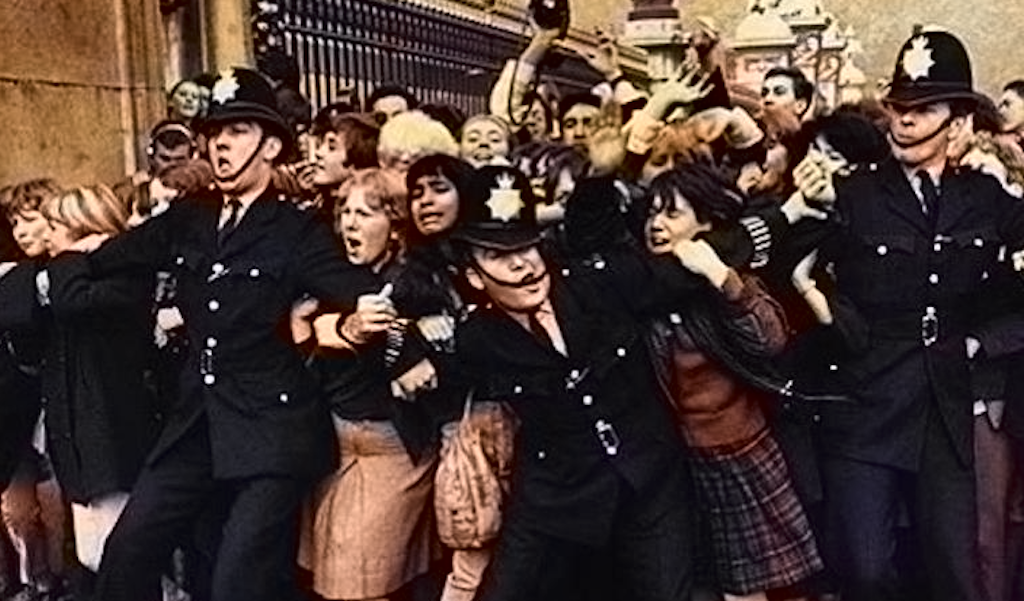
Well-documented but not well-understood, the concept of mass hysteria goes back for many generations and defines instances when many people believe in a false affliction or circumstance. Psychologists throughout history have thoroughly examined many cases of hysteria epidemics, but, so far, there are only guesses as to what lies behind the mysterious condition. We’ll take a look at the various types of hysteria and a number of the weirdest examples documented in history.

Mass hysteria at a Beatles event. CC2.0 miragekale. Image colorized and enhanced.
Is Mass Hysteria A Woman’s Condition?
The term hysteria is an indicator of the erroneous myth surrounding the cause and nature of the phenomenon. Hystera, a Greek word, meaning “uterus,” is the root of the term hysteria. Ancient Greek physicians believed that hysteria only affected women and was caused by a variety of problems with the womb.
[blockquote align=”none” author=”Shalome Sine”]Academia recognized that the roots of the word ‘hysteria’ were offensive to women and stalled the progress of psychology as a science. They reach down to the Victorian era of sexual suppression and ridiculous ideas about the functions of a uterus. The word itself had to be removed, and it has.[/blockquote]
Clearly, the idea that hysteria afflicts only women is ludicrous. Across the world, men have experienced a frightening type of mass hysteria called Koro, or genital shrinkage anxiety. In this situation, multiple men believe their penises are retracting or disappearing altogether. In 1976, 350 men in Thailand believed they were experiencing Koro as a result of Vietnamese food and tobacco poisoning. Then once again, a hysteria epidemic struck in South India in 2010 when 100 men from three labor camps believed they were experiencing Koro. However, perhaps the worst case came from China in 1984-1985 from 3,000 men who reported their panic in 16 different regions.
Criminal Hysteria
In the late 1700s, there was a series of attacks on women in London. Newspapers termed the perpetrator, “the London Monster.” An 18th-century stalker, the offender approached wealthy women from behind, slashed their clothing and stabbed their buttocks. To protect themselves, women wore copper petticoats or placed copper pots and pans under their dresses.
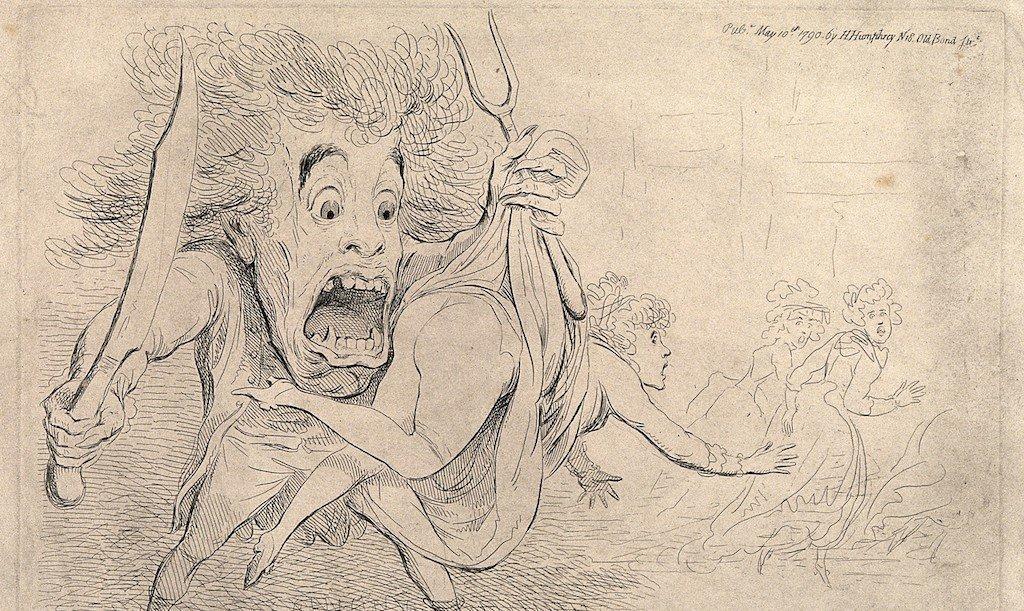
This cartoon came out in 1790 in response to reports of the London Monster. CC4.0 James Gillray.
London Monster attacks continued off and on for two years, but the police started to suspect there was something strange going on. Descriptions of the Monster varied greatly from attack to attack. Some even added the bizarre detail of knives attached to his knees. After two years, the attacks stopped, and although there was an arrest, historians now wonder if women weren’t cutting their own clothes and convincing themselves that the Monster had harmed them.
Centuries later, a similar incident occurred in Halifax, England. On November 16, 1938, two women reported that a stranger with a mallet attacked them. In the next few weeks, more women and several men reported similar attacks but with different weapons. Such varying reports frustrated the police. Eventually one of the “victims” confessed he had inflicted the wounds on himself. There were a few similar confessions, but many victims insisted that a strange man attacked them. This, however, did not convince the police. So, they closed the investigation.
Medical Hysteria
Mass hysteria does not always involve some sort of violence. Mumbai experienced their own hysteria epidemic involving their regular water supply. In 2006, many people living in an area near the Mahim Creek described the normal saltwater as tasting especially sweet, as if someone had doctored it with sugar or syrup. This seemed impossible to authorities, as the creek was regularly used as a depository for raw sewage and industrial waste.
The belief in the altered water spread to other populations living near other toxic waterways. People began drinking the bad water much to the concern of local medical professionals who attempted to stop the consumption. Indeed there was a real possibility of disease spreading throughout the area. Mysteriously, the following day, the populace found the water to be as foul and salty as it had been before this brief spell of suspended belief.
Teen Hysteria
Young students were often the focus of mass hysteria epidemics. In May of 2006, a swarm of Portuguese teens reported strange illnesses. The situation became so serious that several schools were closed in the face of an apparent epidemic. As it turned out, the teens who initially manifested the symptoms had watched a particular soap opera on TV where one of the characters was experiencing the same symptoms. Experts concluded that the teens who first reported their illness had “contracted” the symptoms from the fictional character and then influenced other teens to believe that they had the same illness.
On the other side of the globe, a Louisiana high school senior named Helen attended her school’s homecoming dance which followed the traditional homecoming game. The dance began normally, but at some point, during the evening Helen’s right leg began to spasm for no apparent reason. The episode continued for the entirety of the dance and didn’t stop the next day. Eventually, other students began suffering from the same symptom, and students manifested leg twitching of a similar nature. Nobody could understand the cause of the situation. Some parents went so far as to keep their children at home for fear of them catching whatever it was that was making the teens twitch. The strange physical symptom continued for some time but, as in many cases of mass hysteria, the behavior stopped on its own. The trigger for the abnormal episodes remains a mystery.
Tanganyika Laughter Epidemic
In a Tanzanian girls school in January of 1962, a suspected episode of mass hysteria baffled school officials and medical experts. While in school, three girls started to laugh for no apparent reason. Teachers tried to stop the disruption with threats of punishment, but the girls kept laughing. Sometimes the girl would laugh for a matter of hours but sometimes they laughed for a matter of days.

Students are recreating the laughing hysteria experienced in Tanganyika. Twitter.com.
Soon almost 100 students in the school were laughing, and the behavior then spread to nearby villages. Parents panicked and withdrew their daughters from the schools until the situation ended. Some experts theorize that the hidden physical and mental changes of puberty may cause mass hysteria among teens.
Religious Hysteria
Mass hysteria did not affect only the secular population. There are two known instances of convents of nuns supposedly being caught up in episodes of hysteria. In medieval France, for example, a nun suddenly began meowing as if she were a cat. Instead of the other sisters trying to stop her from this strange behavior, they started meowing too. Neighbors were at first puzzled. But, when the noise started going far into the night, the locals sought help from the nearby military. The soldiers were able to stop the puzzling behavior with threats of physical punishment.
Similarly, in Germany, a solitary nun began biting her religious sisters for no apparent reason. The other nuns inexplicably began to bite other people too. This epidemic spread to neighboring nunneries and even into neighboring countries. Eventually, the episode ended as mysteriously as it had begun.
The infamous Salem Witch Trials are also a candidate for religious hysteria. Some researchers theorize that one or two young girls originally believed that the adult neighbors who had made a pact with the devil tortured them. Soon, several other girls began exhibiting the same frenzy of symptoms. It took several weeks and quite a few unfortunate executions to declare the symptoms psychological instead of demonical.

One estimation places deaths of people accused of witchcraft in the hundreds of thousands. Image: 1892, Public Domain.
Animal Hysteria
Another purported case of mass hysteria involves the recent appearance of the cryptological creature known as the Chupacabra. This is a fierce and mysterious animal that lives in the shadows of places such as Puerto Rico and Mexico. Literally meaning “goat sucker,” the Chupacabra drains the blood of sheep and goats by way of violent wounds to their bodies. However, the descriptions of the beast vary somewhat. A few accounts say the creature has reptile-like scales, hops like a rabbit, and is less than five feet tall. Others liken its appearance to that of a fearsome breed of dog.
Many scientists do not believe that such a creature exists. However, the populace of many areas scattered around the Caribbean Sea and the Gulf of Mexico firmly believe that the Chupacabra is a real animal. Villagers often believe reports of sightings, and if livestock dies, they assume it is due to the vicious cryptid animal.
Mass Hysteria in the Dancing Plague
Finally, perhaps the most infamous case of mass hysteria occurred in Strasbourg, France, in the summer of 1518. It started with one woman dancing in the streets for no apparent reason. Nobody could stop her. Indeed, many of her neighbors joined her instead. By a month’s time, approximately 400 villagers were also dancing in what became known as the Dancing Plague.
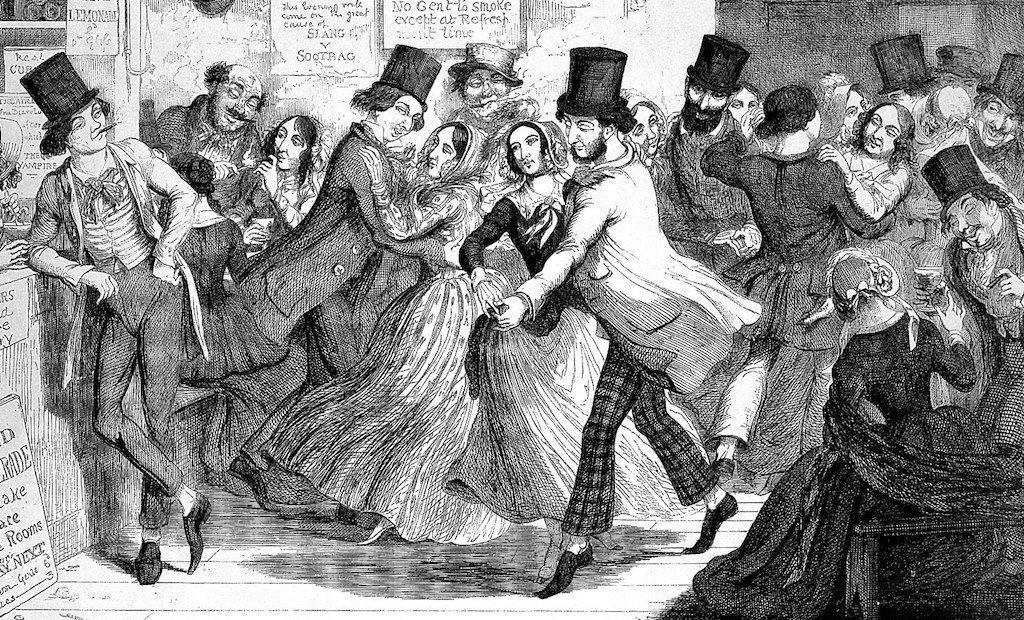
There have been a number of reports of dancing hysteria in history. CC 4.0, George Cruikshank.
Some dancers suffered no ill effects. However, others died from causes such as exhaustion and heart failure. A number of political and medical records of the time document the phenomenon thoroughly. Once again, the strange behaviors ended as mysteriously as they had begun.
There are many examples of mass hysteria. Some of them are somewhat benign, like laughing or dancing. However, other forms may be highly toxic, such as the genocide movement of the Nazis. What causes this mysterious phenomenon? Many theories exist, but the jury is still out. Meanwhile, there will undoubtedly be more instances of the strange phenomenon in the future.
References:
Frater, Jamie. “Top 10 Bizarre Cases of Mass Hysteria.” Listverse, December 29, 2016.
Sine, Shalome. “On the Sexist Etymology of ‘Hysteria,” and What Academia Did about It.” Medium. Medium, September 18, 2015.
Traniello, Vanessa. “Hysteria and The Wandering Womb.” Marquette University. Accessed September 17, 2019.